


死亡笔记
China, Russia launch fourth joint Arctic scientific expedition, process lasts about 62 days: report_我的网站

A |
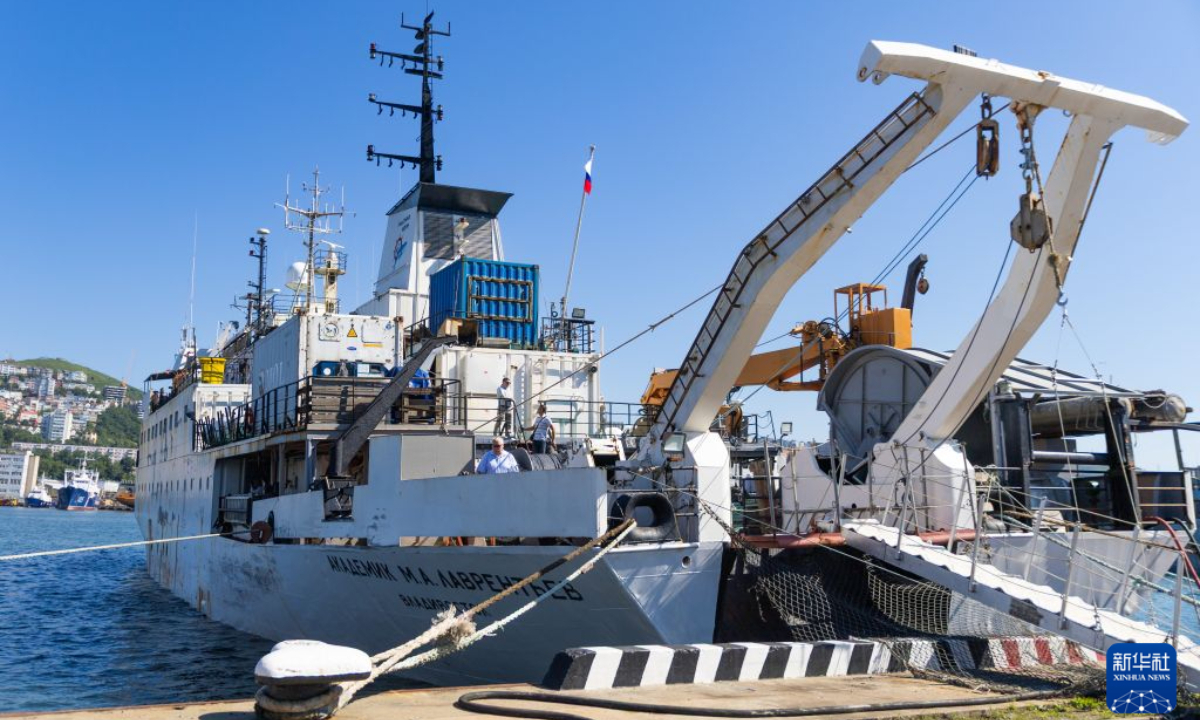
The fourth China-Russia joint Arctic expedition was launched on Thursday in Russia’s Far Eastern city of Vladivostok. Scientists from both countries will conduct major frontier basic research on the rapid climate changes in the Arctic region, focusing on the area from the Northwest Pacific to the Arctic Ocean, Xinhua News Agency reported on Thursday. Nine people from China will participate in the voyage.
At the launch ceremony, Wei Zexun, director of the First Institute of Oceanography, Ministry of Natural Resources (MNR), said the joint expedition will focus on the waters of the Northwest Pacific and the Arctic Ocean, further deepening scientific understanding of ocean dynamic processes, climate change patterns, and marine ecosystems in the study areas. It is not only a concrete measure to implement the cooperation consensus between China and Russia in the marine field, but also a vivid example of the two countries’ comprehensive strategic partnership of coordination in marine science and technology in the new era.
According to Du Libin, executive dean of the College of Ocean Science and Engineering, Shandong University of Science and Technology, the Arctic is highly sensitive to global climate change, and a frontier for ocean science, playing a key role in the “Polar Silk Road” initiative and China-Russia polar marine cooperation.
The joint expedition will highlight deeper marine research cooperation and innovation, while advancing polar scientific exploration and practical collaboration between the two countries, Du said.
According to Zou Jianjun, chief Chinese scientist of the scientific expedition team and a researcher at the First Institute of Oceanography, MNR, the expedition will last about 62 days. The scientists will conduct multidisciplinary surveys in the Chukchi Sea, East Siberian Sea, Lomonosov Ridge, Makarov Basin, and Amundsen Basin to study changes in the marine environment of these regions amid rapid climate change and reveal their response processes and feedback mechanisms in relation to global climate change.
A representative from the Pacific Oceanological Institute (POI), Far Eastern Branch of the Russian Academy of Sciences, said during the ceremony that the joint expedition is expected to strengthen Russia-China ties and expand cooperation in the Arctic and Pacific regions.
As freight volumes along the Arctic shipping route are steadily increasing, and the role of Arctic shipping route in the global economy is becoming increasingly important, comprehensive scientific research of the region has become necessary.
Global Times
。
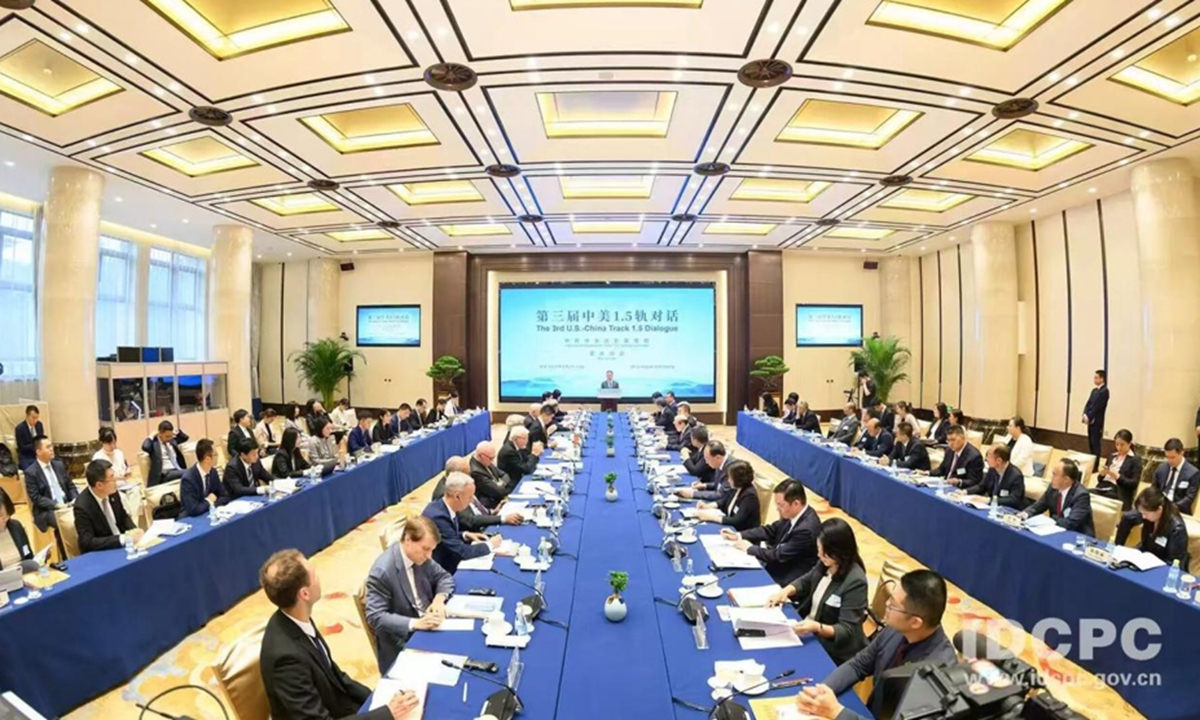
The third China-US Track 1.5 Dialogue was held in Beijing on Tuesday, bringing together government officials, scholars and business representatives from both countries for discussions on constructive strategic stability and practical cooperation.
Co-hosted by the International Department of the Central Committee of the Communist Party of China (IDCPC) and the Asia Society, the dialogue was attended by about 40 representatives. Participants included officials from relevant Chinese government departments and local governments, experts from think tanks and universities, as well as figures from US strategic and business circles, including John L. Thornton, co-chair of the Asia Society Board of Trustees.
Under the theme "Constructive Strategic Stability - Practical China-US Cooperation in the New Era," the participants held candid, in-depth and constructive exchanges, according to the IDCPC's release on its WeChat account on Tuesday.
Addressing the dialogue, Liu Haixing, head of the International Department of the CPC Central Committee, said the two sides have recently followed the direction set by the two heads of state, taken practical steps to strengthen communication and dialogue, advanced a positive agenda and achieved notable results.
Liu called on the two countries to continuously enlarge common interests and make cooperation the anchor of positive stability. He urged the two countries to uphold mutual benefit and reject zero-sum games so that competition remains within bounds, to seek common ground while managing differences, and observe the bottom line of no conflict and no confrontation to achieve lasting peace and stability.
Participants discussed ways to enhance political mutual trust, expand economic and trade cooperation, and explore cooperation in artificial intelligence, science and technology, CCTV News reported.
Established in 2023, the China-US Track 1.5 Dialogue operates between formal government-to-government diplomacy, known as Track 1, and purely nongovernmental exchanges, known as Track 2. The second dialogue was held on June 13, 2024, during which participants held candid, in-depth and constructive exchanges around the theme of "sharing perspectives and finding solutions on key and urgent issues."
As a channel involving both government and nongovernmental participants, the Track 1.5 mechanism can help China and the US communicate more effectively, identify common ground and better understand the consensus reached by the two heads of state, Zhou Mi, a senior research fellow at the Chinese Academy of International Trade and Economic Cooperation, told the Global Times on Tuesday.
It can also help translate the consensus into greater mutual understanding and concrete action, Zhou said.
Discussions on AI at this year's dialogue could help the two sides identify shared interests despite existing frictions and technological challenges, creating opportunities for practical cooperation and laying the groundwork for follow-up efforts, he noted.
Wang Yiwei, a professor at the Renmin University of China's School of International Studies, told the Global Times on Tuesday that the Track 1.5 dialogue serves as a bridge between Track 1 and Track 2, allowing participants to discuss sensitive issues and explore policy space while conveying frontline assessments and feasible proposals to decision-making departments.
Liu outlined practical pathways for China-US cooperation in the new era. First, the two sides should uphold mutual respect, peaceful coexistence and win-win cooperation, steer China-US relations to overcome the "Thucydides Trap," and create a new paradigm of major-country relations.
Second, the two countries should jointly shoulder their responsibilities as major powers, make constructive interaction an important driver of international cooperation, address global challenges together and inject greater stability into the world, Liu noted.
Third, they should expand exchanges and cooperation in trade, public health, agriculture, tourism, people-to-people ties, law enforcement and cooperation between localities, thereby strengthening the resilience of bilateral relations and working toward a better future, Liu said.
Overcoming the "Thucydides Trap" fundamentally rejects the notion that conflict between major powers is inevitable, Wang Yiwei said. It reflects an effort by China and the US to pursue a path different from the historical confrontation between an established power and a rising one.
Such a model does not seek to avoid competition altogether, but to ensure that competition has boundaries, differences remain manageable and cooperation retains sufficient space, Wang Yiwei said.
To put this approach into practice, the two countries should respect each other, avoid crossing red lines concerning core interests and reduce the risk of strategic miscalculation. They should expand areas where their interests converge and establish regular cooperation mechanisms on global issues such as climate change, public health, food security and AI safety, turning shared responsibilities into joint action, he noted.
As the world's two largest economies, China and the US should recognize that many global challenges cannot be effectively addressed without coordination between them, particularly at a time of intensifying competition. Constructive engagement is therefore not a temporary expedient but a long-term responsibility that major countries should undertake for the world, Wang Yiwei said.
The dialogue came a day after China's top political advisor Wang Huning met with US delegates attending the event in Beijing on Monday.
During their meetings, the US side said that the US-China relationship is at a special juncture, adding that the sound rapport between the two heads of state constitutes the most valuable and important part of bilateral ties. The US side agrees that both sides should act on the consensus of building a constructive US-China relationship of strategic stability, advance corporate cooperation, expand people-to-people and cultural exchanges, guard against risks such as those posed by artificial intelligence, and deliver benefits to both countries and the rest of the world, according to Xinhua.
。
Current article:http://w5cjldc.xuebenwagangqingre.buzz/list_v18/c8jj8.html
Published on:10:23:52
 奇瑞多米/小蚂蚁喜爱版/冰淇淋元气版上市 售3.99万起 QQ家族壮大
 重磅!宁夏福彩“畅玩3D 单选有礼”赠券促销活动今日正式启动!
 莱临高铁纳入国家“十五五”交通规划意味着啥?盘活济莱高铁,济临1小时直达
 《湮灭之潮》全新剧情预告 女主新形象曝光
 专家称,梅根夫妇的“小丑秀”让王室处于危险境地,王室不会轻易放过其
 「マジ!?」 56歳レジェンドセクシー女優が自叙伝出版 桜樹ルイの近影に「可愛すぎる」「いつまでもお美しい」
 【观点】广州期货:矿端偏紧支撑,沪锌偏多运行
 王群大使:中方主张下,一些国家劫持国际原子能机构理事会图谋被挫败_三国_合作
 明晨全部出炉!欧冠36席已定32席:一档豪门扎堆 闪耀连续2年参赛
 美光4TB SSD坏了拒换新!称库存耗尽只退原价:用户硬刚到底终获换货
 2025年淘宝京东618活动哪天买最便宜优惠力度最大?确认6月17日20点开始到18日全天
 【东城中心幼儿园·工会】新岁启封·同赴新程